Becoming a notary public in California takes 6-8 weeks and costs $400-600. You'll need to complete a 6-hour course, pass a state exam, clear a background check, and file your commission. This comprehensive guide walks you through every step.
Quick Overview: California Notary Process
Basic Requirements:
- ✓ 18 years or older
- ✓ California legal resident
- ✓ Pass background check
- ✓ Pass state exam (70% minimum)
- ✓ Complete 6-hour course
Time & Cost:
- ✓ Total timeline: 6-8 weeks
- ✓ Total cost: $400-600
- ✓ Commission: 4 years
- ✓ Exam pass rate: ~65%
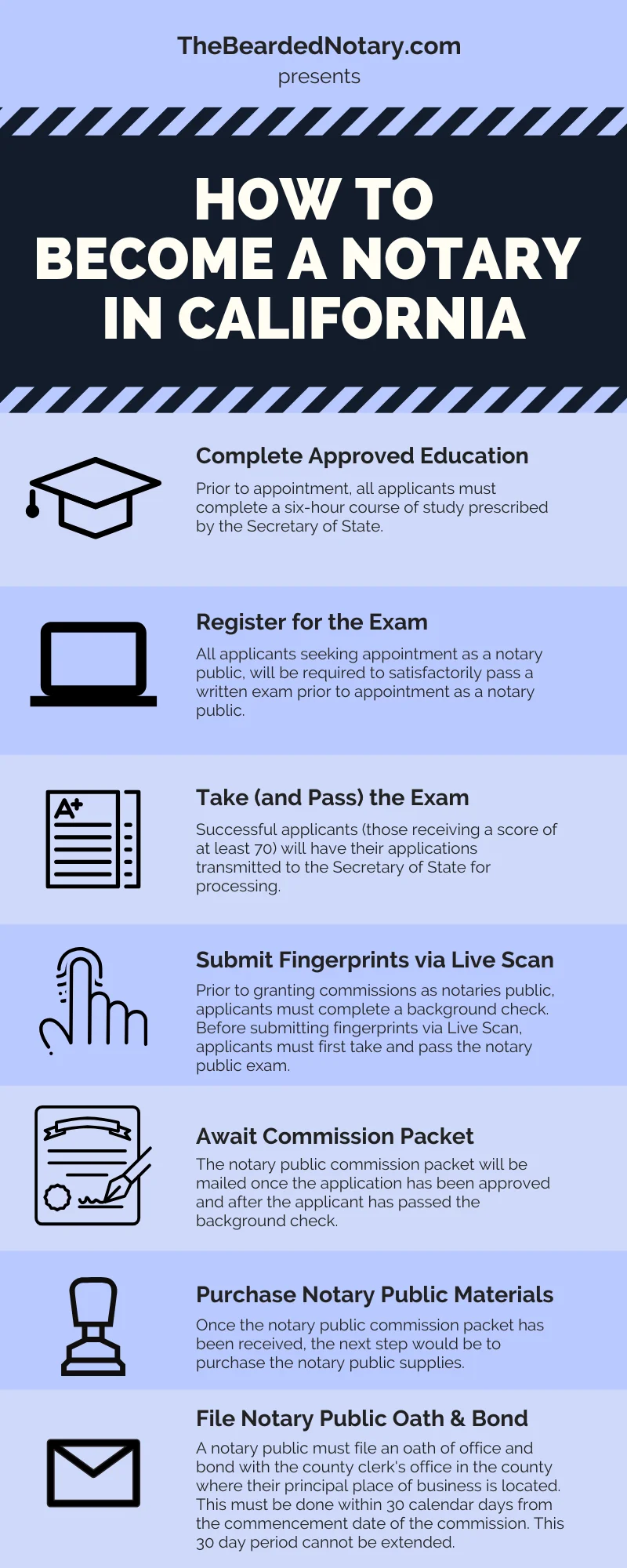
Why Become a California Notary?
California is one of the best states for notary income. Here's why:
California Notary Advantages
- $15 per signature - Highest maximum fee in the nation (tied with Washington/Nevada)
- 40 million residents - Massive population = constant demand
- Active real estate market - More home sales = more notarizations
- Unlimited travel fees - Mobile notaries add $25-75 per appointment
- Flexible income - Part-time side hustle or full-time career
Income potential: Part-time mobile notaries earn $1,500-3,000/month. Full-time loan signing agents can earn $6,000-12,000/month. See our complete pricing guide.
California Notary Requirements
Before you begin the process, make sure you meet these eligibility requirements:
✓ Age: 18 or Older
You must be at least 18 years old on the date you submit your application.
✓ Residency: California Legal Resident
You must be a legal resident of California. You do NOT need to be a U.S. citizen, but you must have legal presence in the state.
✓ Background: Pass Criminal Check
You must pass a background check via Live Scan fingerprinting.
Disqualifying offenses:
- Any felony conviction
- Conviction involving dishonesty, fraud, or deceit
- Conviction for a crime involving moral turpitude
- Revoked notary commission in CA or another state
Note: Minor traffic violations and parking tickets do NOT disqualify you.
✓ Education: 6-Hour Approved Course
Must complete a state-approved 6-hour notary education course before taking the exam. Renewals require a 3-hour refresher course.
✓ Exam: Pass with 70% or Higher
Must score at least 70% (42 out of 60 questions correct) on the California Notary Public Exam.
How Much Does It Cost to Become a California Notary?
Expect to spend $400-600 total to become a California notary. Here's the complete breakdown:
Complete Cost Breakdown
| Item | Cost | Required? |
|---|---|---|
| 6-Hour Education Course | $50-150 | Yes |
| Exam + Application Fee | $40 | Yes |
| Live Scan Fingerprinting | $70-100 | Yes |
| Notary Bond ($15,000) | $40-60 | Yes |
| Notary Stamp/Seal | $25-40 | Yes |
| Notary Journal | $15-25 | Yes |
| E&O Insurance (recommended) | $50-150/year | No, but highly recommended |
| Business Cards | $20-50 | No |
| Additional Supplies | $30-50 | Recommended |
| TOTAL | $400-600 | - |
Good news: Your commission lasts 4 years. If you complete just 10 mobile notarizations at $50 each, you've covered your costs. Everything after that is profit.
How Long Does It Take to Become a California Notary?
Total timeline: 6-8 weeks from start to finish if you move efficiently. Here's the week-by-week breakdown:
Timeline Breakdown
Week 1: Education
Complete 6-hour course (can finish in 1-2 days online)
Week 2: Study & Schedule Exam
Study course materials + Notary Public Handbook. Schedule exam (usually 1-2 weeks out)
Week 3: Take Exam
Take and pass exam. Complete Live Scan fingerprinting same week.
Weeks 4-6: Processing
Secretary of State reviews application and background check (2-4 weeks)
Week 7: Commission Packet Arrives
Purchase bond and supplies. File oath and bond at county clerk (must be within 30 days)
Week 8: Start Working!
You're officially commissioned and can begin notarizing
⚠️ CRITICAL DEADLINE: You have 30 calendar days from your commission start date to file your oath and bond. Miss this deadline and your commission is void - you'll have to start over.
Step-by-Step: How to Become a California Notary
Now let's walk through each step in detail:
Complete 6-Hour Approved Education Course
All first-time notary applicants must complete a 6-hour course approved by the California Secretary of State. (Renewals only need 3 hours.)
What the Course Covers:
- California notary laws and regulations
- Proper notarization procedures
- Types of notarial acts (acknowledgments, jurats, oaths)
- How to identify signers and verify documents
- Journal requirements and record-keeping
- Common mistakes and how to avoid them
- Ethics and liability
Where to Take the Course:
The Secretary of State maintains a list of approved education vendors. Popular options:
- Online courses: $50-100, complete at your own pace
- In-person classes: $100-150, one-day workshops
- Recommended: National Notary Association (NNA) - comprehensive, well-reviewed
Time commitment: 6 hours total. Online courses can be completed in 1-2 days.
Proof of completion: You'll receive a certificate that you MUST bring to the exam. Keep this safe!
Schedule Your Notary Exam
The California Notary Public Exam is administered by CPS HR Consulting, the state's contracted testing provider.
How to Schedule:
- Visit cpshr.us/exams/notary
- Select "Schedule an Exam"
- Choose your preferred test location (available statewide)
- Pick a date (exams offered multiple times per week)
- Pay the $40 exam + application fee
Exam availability: Tests are offered year-round at multiple locations throughout California. Most applicants can find a slot within 1-2 weeks.
Pro tip: Schedule your exam 1-2 weeks out to give yourself time to study, but not so far out that you forget the material.
Study for and Pass the Exam
The California Notary Public Exam consists of 60 multiple-choice questions. You need to score 70% or higher (42+ correct answers) to pass.
Exam Stats You Should Know:
- • Pass rate: Approximately 65% (1 in 3 people fail)
- • Time limit: No time limit (most finish in 45-60 minutes)
- • Retake policy: Can retake if you fail (costs $20)
- • Difficulty: Moderate - requires thorough studying
What's on the Exam:
- California notary laws and procedures (40%)
- Types of notarial acts and when to use them (25%)
- Proper identification requirements (15%)
- Journal entries and record-keeping (10%)
- Ethics, liability, and misconduct (10%)
How to Study Effectively:
- Download the Notary Public Handbook - Available free from the California Secretary of State. This is your primary study resource.
- Review your course materials - Go through your 6-hour course notes
- Take practice tests - Your course provider likely includes practice exams. Take them multiple times until you're consistently scoring 80%+
- Focus on high-weight topics - Know the difference between acknowledgments, jurats, and oaths. Understand ID requirements cold.
- Study for 1-2 weeks - 30-60 minutes per day is sufficient for most people
What to Bring to the Exam:
- Valid photo ID (CA driver's license or DMV ID card)
- Completed Notary Public Application form
- 2" x 2" color passport photo
- Proof of completion certificate from your 6-hour course
- Registration confirmation
- $40 fee (check or money order - NO CASH)
Exam day tips: Arrive 15 minutes early. Read each question carefully. Don't overthink - the answers are usually straightforward. If you don't know an answer, skip it and come back.
Complete Live Scan Fingerprinting
After passing your exam, you must complete a background check via Live Scan fingerprinting. This must be done within one year of passing the exam.
How to Complete Live Scan:
- Download the Request for Live Scan Service form from the Secretary of State website
- Complete the form (include your OCA number from your exam results)
- Find an authorized Live Scan provider near you (police stations, UPS stores, private fingerprinting services)
- Bring valid photo ID and the completed form
- Pay the Live Scan fee ($70-100 depending on provider)
- Results are sent electronically to the Secretary of State
Processing time: Background check results are usually processed within 1-3 weeks.
Pro tip: Complete your Live Scan the same week you pass your exam to keep momentum going.
Await Your Commission Packet
Once your application is approved and your background check clears, the Secretary of State will mail your commission packet to your address of record.
What's in the Commission Packet:
- Cover letter with instructions
- Notary Public Commission Certificate (your official license!)
- Two Notary Public Oath and Certificate of Filing forms
- Certificate of Authorization to Manufacture Notary Public Seals
- List of authorized seal manufacturers
- Filing instructions
Timeline: Expect to wait 2-4 weeks after completing Live Scan for your packet to arrive.
Important: Your commission start date is printed on your certificate. You have 30 days from this date to file your oath and bond. The clock is ticking!
Purchase Required Supplies
Once you receive your commission packet, immediately purchase your required supplies. You'll need these to file your oath and bond.
1. Notary Bond ($15,000)
Cost: $40-60 for 4 years
Required: Yes - must be filed with county clerk within 30 days
What it is: A $15,000 surety bond that protects the public if you make an error. This does NOT protect you - it protects clients.
2. E&O Insurance
Cost: $50-150/year ($25,000-$100,000 coverage)
Required: No, but HIGHLY recommended
What it is: Errors & Omissions insurance protects YOU if you make a mistake. The bond protects the public; E&O protects your personal assets.
Recommendation: Get at least $25,000 E&O. If you plan to do loan signings, get $100,000 (title companies often require it).
3. Notary Stamp/Seal
Cost: $25-40
Required: Yes
Where to buy: Only from manufacturers on the authorized list included in your commission packet. Do NOT buy from Amazon or random online sellers - your stamp must meet specific California requirements.
Requirements: Must include your name, commission number, county, and expiration date in the exact format required by law.
4. Notary Journal
Cost: $15-25
Required: Yes - you must keep a sequential journal of ALL notarial acts
Specifications: Must be bound (not spiral), tamper-evident, with sequential page numbers. Available from notary supply vendors or office supply stores.
See our complete Mobile Notary Supplies Checklist for additional recommended items (business cards, pens, folders, etc.).
File Your Oath and Bond at County Clerk
This is the final step! You must file your oath of office and notary bond with the county clerk in the county where your principal place of business is located.
🚨 CRITICAL DEADLINE: 30 Calendar Days
You must file your oath and bond within 30 calendar days of your commission start date (printed on your certificate). This deadline CANNOT be extended. Miss it and your commission is void - you'll have to reapply and start over.
How to File:
- Locate your county clerk's office - Usually in the county courthouse or government building
- Gather required documents:
- Original notary bond from bonding company
- Completed Oath of Office form (from your commission packet)
- Your commission certificate (bring original + photocopy)
- Valid photo ID
- Visit in person - While some counties accept mail filings, in-person is STRONGLY recommended to ensure timely processing
- Take oath before county clerk - You'll raise your right hand and swear the oath
- Pay filing fee - Varies by county, typically $20-50
- Receive filed stamp on your documents - This is proof you're officially commissioned
Pro tip: Call your county clerk's office ahead of time to confirm:
- Office hours and location
- Accepted payment methods
- Any additional requirements
🎉 Congratulations!
Once you file your oath and bond, you are officially a commissioned California Notary Public! You can immediately begin performing notarizations.
What to Do After You're Commissioned
You're now a California notary. Here's what to do next:
1. Set Up Your Business Systems
- Create a Google Business Profile (free, gets you found in "notary near me" searches)
- Order business cards with your name, phone, email, and "California Notary Public"
- Set up separate business finances—business bank account, expense tracking, mileage log. See our money management guide for the exact setup process.
- Set up payment methods (Venmo, Zelle, Square for credit cards)
- Create a simple pricing structure (see our pricing guide)
2. Market Your Services
- List yourself on free sites like Yelp, Bing, Nextdoor (see our 10 free marketing sites)
- Join local Facebook groups and introduce yourself
- Network with real estate agents, law firms, senior living facilities
- Post on Craigslist under Legal Services
3. Consider Loan Signing Certification
General notaries earn $15-50 per appointment. Loan signing agents earn $100-200 per signing. The training pays for itself in 2-3 signings.
Learn more: Why 2026 is the Perfect Time to Become a Loan Signing Agent
4. Get Your First Client
Start by offering to notarize documents for friends, family, coworkers (charge them - you need the practice and the reviews!). Ask them to leave you a Google review after.
Ready to Build Your Notary Business?
Follow our 30-day action plan for new notaries. Day-by-day checklist to go from "just commissioned" to "earning $1,000+ per month."
Read the 30-Day Action PlanHow to Renew Your California Notary Commission
Your California notary commission is valid for 4 years. You can begin the renewal process up to 6 months before your expiration date.
Renewal Process (Shorter than Initial)
- Complete 3-hour refresher course (instead of 6 hours) - must be done before your current commission expires
- Take and pass the exam - same 60-question test, 70% to pass
- Complete Live Scan - background check required again
- Receive new commission packet
- Purchase new bond and supplies (new stamp with updated expiration date)
- File oath and bond - same 30-day deadline
Total renewal cost: $300-450 (slightly less than initial because the course is shorter)
Pro tip: Start your renewal 3-4 months before expiration to avoid any gap in your commission. This is especially important if you rely on notary income.
Common Mistakes to Avoid
❌ Missing the 30-Day Filing Deadline
This is the #1 mistake. File your oath and bond IMMEDIATELY when you receive your commission packet. Don't wait until day 29. If you miss this deadline, your commission is void and you start over from scratch.
❌ Buying Unauthorized Stamps
Only purchase stamps from manufacturers on the Secretary of State's authorized list (included in your commission packet). Amazon stamps are NOT acceptable and using one can result in discipline.
❌ Not Getting E&O Insurance
Your bond protects the public, not you. One lawsuit could wipe out your personal savings. Get E&O insurance ($50-150/year) before your first notarization.
❌ Not Studying Enough for the Exam
35% of test-takers fail. Don't be overconfident. Study for 1-2 weeks, take practice exams, and aim for 80%+ on practice tests before taking the real exam.
❌ Notarizing for Family Without Proper Procedure
Just because they're family doesn't mean you can skip steps. You CANNOT notarize for anyone with a financial interest in the document. Follow all ID verification and journal requirements - every time.
Frequently Asked Questions
How long does it take to become a notary in California?
6-8 weeks total from starting your education course to receiving your commission. This includes 1 week for the course, 1-2 weeks studying and scheduling, taking the exam, 2-4 weeks for background check and processing, and 1 week to file your oath and bond.
How much does it cost to become a notary in California?
$400-600 total. This includes: 6-hour course ($50-150), exam + application fee ($40), Live Scan fingerprinting ($70-100), notary bond ($40-60), stamp ($25-40), journal ($15-25), and optional E&O insurance ($50-150/year).
What are the requirements to become a notary in California?
You must be: (1) 18 years or older, (2) a legal California resident, (3) pass a criminal background check, (4) complete a 6-hour approved education course, and (5) pass the state exam with 70% or higher.
How hard is the California notary exam?
Moderately challenging. The pass rate is approximately 65%, meaning 35% of test-takers fail. You need to score 70% (42 out of 60 questions correct). With 1-2 weeks of studying using the Notary Public Handbook and practice exams, most people pass on their first attempt.
Can I become a notary if I have a felony?
No. Any felony conviction disqualifies you from becoming a California notary public. Convictions involving dishonesty, fraud, deceit, or moral turpitude also disqualify. Minor misdemeanors and traffic violations generally do not disqualify you.
Do I need to be a US citizen to become a California notary?
No, you do not need to be a U.S. citizen. You must be a legal resident of California, but citizenship is not required.
How much can I make as a California notary?
Part-time mobile notaries typically earn $1,500-3,000/month. Full-time mobile notaries can earn $3,000-6,000/month. Full-time loan signing agents (with specialized training) can earn $6,000-12,000/month. California allows $15 per signature (highest in the nation) plus unlimited travel fees.
How long is a California notary commission valid?
4 years. Your commission start and expiration dates are printed on your certificate. You can begin the renewal process up to 6 months before expiration.
Do I need E&O insurance to become a California notary?
No, E&O (Errors & Omissions) insurance is not legally required in California. However, it is HIGHLY recommended. Your required $15,000 bond protects the public if you make an error - it does not protect you. E&O insurance protects your personal assets. Cost: $50-150/year for $25,000-$100,000 coverage.
What happens if I fail the California notary exam?
You can retake the exam. The retake fee is $20 (instead of the initial $40). There is no limit on how many times you can retake, but you must retake within one year of completing your education course. If you fail multiple times, consider studying more thoroughly or retaking the 6-hour course.
Can I notarize for family members in California?
Maybe. You can notarize for family members UNLESS you have a financial interest in the transaction. For example, you cannot notarize a deed if you're inheriting property, or notarize a loan document if you're a co-borrower. When in doubt, refer the family member to another notary to avoid any appearance of conflict of interest.
Where can I take the California notary course online?
The California Secretary of State maintains a list of approved online education providers at sos.ca.gov/notary/education/. Popular options include National Notary Association (NNA), Notary Public Underwriters, and Signing Agent Mentor. Courses cost $50-150 and can be completed in 1-2 days at your own pace.
Do I need to pass the exam to get my notary commission?
Yes, passing the state exam with a score of 70% or higher is mandatory. There are no exemptions - even attorneys and government officials must pass the exam to become notaries in California.
Can I start notarizing immediately after passing my exam?
No. You cannot perform notarizations until you have: (1) received your commission packet from the Secretary of State, (2) purchased your bond and supplies, and (3) filed your oath and bond with the county clerk. Only after filing are you officially commissioned and authorized to notarize.
What is the pass rate for the California notary exam?
Approximately 65% of test-takers pass on their first attempt. This means roughly 1 in 3 people fail. The exam is not particularly difficult if you study properly, but it does require thorough preparation. Plan to study 1-2 weeks using the official Notary Public Handbook and practice exams.
Ready to Get Started?
Now that you know the complete process, start with Step 1: Find an approved 6-hour course and get rolling!
Find Approved CoursesWhat to Do After You're CommissionedRelated Resources:
Your First 30 Days as a Mobile Notary
Day-by-day action plan after you're commissioned
California Notary Pricing Guide
What to charge for every type of service
Mobile Notary Supplies Checklist
Everything you need to get started
Why Become a Loan Signing Agent
Earn $100-200 per signing vs $15-50
Smart Money Management for Mobile Notaries
Business accounts, expense tracking, tax deductions, and quarterly planning